
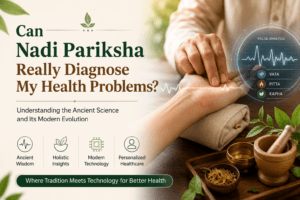
Understanding the Ancient Science and Its Modern Evolution
For thousands of years, Ayurvedic physicians have relied on Nadi Pariksha (Pulse Diagnosis) as a powerful tool to understand a person’s health. By gently examining the pulse at the wrist, experienced practitioners assess the body’s internal balance, identify functional disturbances, and recommend personalized treatments.
But in today’s world of laboratory tests, MRI scans, and advanced diagnostics, a common question arises:
Can Nadi Pariksha really diagnose my health problems?
The answer is both fascinating and nuanced.
What Is Nadi Pariksha?
Nadi Pariksha is a traditional Ayurvedic diagnostic method in which a practitioner evaluates the pulse felt at the radial artery near the wrist. According to Ayurveda, the pulse reflects the dynamic state of the body’s three fundamental energies or Doshas:
- Vata – Movement and nervous system functions
- Pitta – Metabolism and transformation
- Kapha – Structure, stability, and nourishment
Changes in pulse quality, rhythm, strength, and characteristics are believed to indicate imbalances within the body.
Historically, skilled Ayurvedic physicians used pulse examination to gain insights into a patient’s constitution, disease tendencies, and overall wellness.
What Can Nadi Pariksha Reveal?
Nadi Pariksha is often used to assess:
1. Dosha Imbalances
Understanding whether Vata, Pitta, or Kapha is excessive or deficient can help guide dietary, lifestyle, and therapeutic interventions.
2. Functional Disturbances
Pulse patterns may indicate disturbances in digestion, sleep, stress response, energy levels, and overall physiological balance.
3. Early Warning Signs
Many Ayurvedic practitioners believe that pulse changes can appear before clinical symptoms become obvious, allowing for preventive care.
4. Personalized Health Guidance
Rather than focusing solely on disease, Nadi Pariksha aims to understand the individual as a whole and provide customized recommendations.
What Nadi Pariksha Cannot Do
While Nadi Pariksha provides valuable health insights, it is important to understand its limitations.
It cannot directly replace:
- Blood investigations
- Imaging studies (X-ray, CT, MRI)
- Hormone testing
- Biopsy reports
- Emergency medical evaluations
For example, conditions such as diabetes, thyroid disorders, infections, fractures, or cancer require appropriate clinical investigations for confirmation and management.
Responsible healthcare involves integrating traditional wisdom with modern diagnostic methods whenever necessary.
The Challenge of Traditional Pulse Diagnosis
One of the biggest challenges with conventional Nadi Pariksha is subjectivity.
Different practitioners may interpret pulse characteristics differently based on their experience and training.
Questions often arise:
- Can pulse diagnosis be standardized?
- Can observations be measured objectively?
- Can technology improve consistency?
These questions have led researchers and innovators to explore digital solutions.
The Emergence of Digital Nadi Pariksha
Recent advancements in sensors, signal processing, artificial intelligence, and machine learning have opened new possibilities.
Modern digital pulse analysis systems capture pulse waveforms with precision and analyze subtle variations that may be difficult to detect manually.
These systems can:
- Record pulse signals objectively
- Track changes over time
- Generate standardized reports
- Reduce practitioner variability
- Support clinical documentation
The goal is not to replace traditional practitioners but to enhance consistency, repeatability, and evidence-based assessment.
Combining Ancient Wisdom with Modern Technology
The future of healthcare may not lie in choosing between traditional and modern approaches.
Instead, it lies in integrating the strengths of both.
Traditional Nadi Pariksha offers:
- Holistic understanding
- Personalized insights
- Preventive healthcare perspective
Modern technology offers:
- Objective measurements
- Data-driven analysis
- Progress tracking
- Standardization
Together, they can create a more comprehensive view of health.
So, Can Nadi Pariksha Diagnose Health Problems?
The answer is:
Nadi Pariksha can provide valuable insights into your body’s functional balance, tendencies, and overall wellness, but it should not be considered a standalone replacement for modern medical diagnosis.
When combined with scientific evaluation, lifestyle assessment, and appropriate clinical investigations, Nadi Pariksha can become a powerful tool for preventive and personalized healthcare.
Final Thoughts
Healthcare is evolving rapidly. As technology advances, ancient practices like Nadi Pariksha are finding new relevance through digital innovation and scientific validation.
By combining centuries-old wisdom with modern analytical tools, we can move toward a future where healthcare becomes more personalized, preventive, and holistic.
The question is no longer whether traditional knowledge and modern science should coexist.
The real opportunity lies in how effectively we can bring them together to improve human health.